
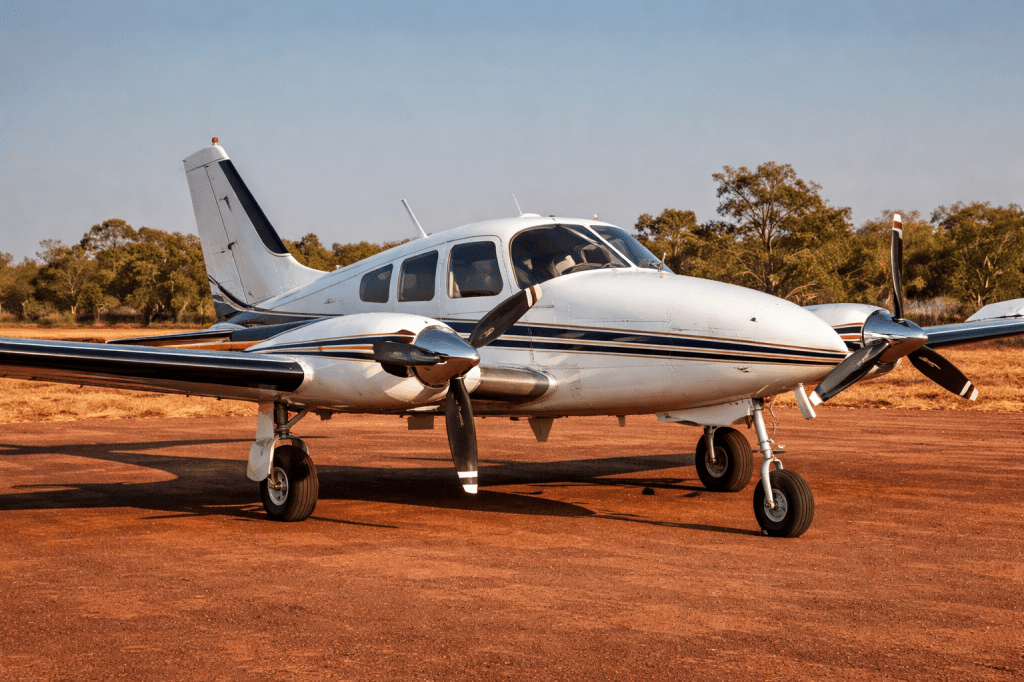
The workhorse of many Australian charter operators remains the piston fleet, aircraft like the Cessna 210 and Cessna 310 that were designed in an era when ‘rugged’ and ‘simple to maintain’ were not marketing slogans so much as survival traits. The catch is obvious: production of 210s ended in 1986, while 310 production wrapped up in 1980. (Aviation Consumer) As of 26 January 2026, that means even the youngest airframes on paper are roughly 39 years old for a 210, and about 45 years old for a 310, before you even start talking about corrosion, fatigue, avionics obsolescence, or the realities of operating from hot, dusty, coastal, or monsoonal environments. (Aviation Consumer)
So does that age matter, particularly when the aircraft is hauling people and freight into places where ‘diversion’ might mean a 400 km drive, and ‘help’ can be hours away? The honest answer is both yes and no, and the nuance is where passengers, regulators, and operators tend to talk past one another.
Australia’s fleet is old, by global standards
Start with the baseline. Australia’s VH-registered general aviation and commercial air transport fleet is ageing, BITRE data shows an average fixed-wing age of 37.2 years in 2021, and notably an average age of 42.3 years for Cessna single-engine aircraft in that same snapshot. (BITRE) That statistic matters for two reasons. First, it tells you the ‘old aeroplane’ conversation is not niche, it is mainstream Australian aviation economics. Second, it hints at why types like the 210 endure: they sit right at the intersection of payload, range, and purchase price that remote operators live and die by.
The ATSB made a similar point in its ageing-aircraft research, it is not just that the fleet is getting older, it is that ‘very few new aircraft have entered the register’ in the piston categories, and older aircraft continue to operate because the economics keep working and replacement options can be limited. (ATSB) That is especially true in remote area ops, where utilisation patterns, runway surfaces, and mission profiles can make a shiny replacement less practical than it looks in a brochure.
The case for older aircraft, the economics passengers actually benefit from
If you want the strongest pro-age argument, it is not romance or nostalgia, it is amortisation.
Lower capital cost can mean lower fares. A paid-off aeroplane, or one acquired at a fraction of the cost of a new-build, carries a very different finance burden. For thin routes, that can be the difference between a service existing at all, versus not pencilling out. The ATSB’s analysis of ageing management explicitly frames replacement versus maintenance as the two core strategies, and notes that general aviation and low-capacity passenger operations often lack the capacity, or the market choice, to simply buy new. (ATSB) For passengers, that can translate directly into price and availability: the flight might be cheaper, and it might exist more frequently, because the operator is not trying to service a fresh loan on every seat-mile.
Mature types have mature knowledge. The 210 and 310 are heavily documented, heavily inspected, and heavily understood by the maintenance ecosystem. A high-time airframe is not inherently unsafe if it is in a programme that understands its known weak points and stays ahead of them.
Parts availability is not zero, it is just not ‘easy’. Owners’ publications point out that, despite production ending decades ago, support and parts channels remain, even if pricing is not friendly. (Aviation Consumer) In remote operations, where a day aircraft on ground (AOG) can ripple into community access, the difference between ‘obtainable’ and ‘unobtainable’ parts matters more than the difference between ‘cheap’ and ‘expensive’.
The case against, ageing is not a vibe, it is a set of failure mechanisms
Now for the bit passengers instinctively worry about, and they are not wrong to worry.
Corrosion is not hypothetical, especially in coastal and humid operations. CASA has been blunt on this for years: corrosion is ‘a real problem’ in older metal aircraft, can render airframes beyond economic repair, and even small corrosion can become major quickly if ignored. (Civil Aviation Safety Authority) Remote operations often stack the deck against you, salt air, humidity, wet-season storage, dust, and cleaning limitations all accelerate the problem if the operator is not aggressive about prevention and detection.
The FAA’s corrosion guidance makes the same point in different language, corrosion can progress quickly, and the right inspection and treatment cadence is the operator’s responsibility, with the operational environment setting the ‘aggressiveness’ of the programme. (Federal Aviation Administration)
Fatigue is real, but it is not ‘age in years’, it is cycles, hours, and loads. The ATSB stresses there is no single criterion that defines an aircraft as ‘old’, because components age differently depending on hours, cycles, and how the aircraft is used. (ATSB) Remote work can be deceptively hard on airframes: short sectors, frequent take-offs and landings, rough strips, higher vibration, and heavier mission loads can push structural and systems wear in ways that a calendar age number does not capture cleanly.
Systems ageing can be as dangerous as structure. Wiring, connectors, hoses, seals, magnetos, alternators, vacuum systems, and landing gear mechanisms do not care about brand reputation. They care about heat, moisture, vibration, and time. Owner reports for the 210, for example, highlight meaningful maintenance burdens and recurring system issues that demand disciplined upkeep rather than optimism. (Aviation Consumer)
Age management only works if operators actually adhere. This is the ATSB’s quietly sharp warning: maintenance programmes and supplementary inspections reduce risk ‘only if the operators adhere to the programmes’. (ATSB) That is the hinge point for passenger trust, and it is where ‘old aircraft’ can be either perfectly acceptable, or a genuinely poor risk.
So, does age predict safety?
Not in the way people hope, and not in the way people fear.
The strongest aviation-integrity framing is this: chronological age is a proxy, not a verdict. It correlates with exposure to corrosion and fatigue mechanisms, and it correlates with the likelihood that multiple systems are approaching wear-out together, but it does not automatically tell you whether an operator is managing those realities well.
The ATSB’s ageing-aircraft work essentially lands on a conditional: ageing can be a safety issue, but the consequences can be mitigated through adequate maintenance, additional and specific inspections, and cooperative continuing airworthiness. (ATSB) CASA’s corrosion bulletin, meanwhile, underscores that the operator’s responsibility does not shrink with age, it grows. (Civil Aviation Safety Authority)
What passengers should look for, the practical checklist
If you are a passenger booking a remote charter, you cannot audit an aircraft yourself, but you can ask questions that reveal whether the operator is serious.
- Ask about the maintenance system, not the aircraft age. ‘Is it maintained to an approved schedule, and do you have additional inspections for ageing aircraft issues like corrosion and fatigue?’ The operator should be able to answer crisply, without defensiveness.
- Ask how they manage corrosion in their environment. In coastal, tropical, or wet-season contexts, a real operator will talk about cleaning, inspections, treatment, and prevention, not vague reassurance. (Civil Aviation Safety Authority)
- Ask about downtime strategy and parts. The safest operators plan for AOG events, spares pathways, and contingency transport because they know remote ops are unforgiving.
- Look for operational maturity signals. Stable crews, conservative weather decision-making, clear passenger briefings, and a culture that treats ‘no’ as a normal answer, are stronger safety signals than the paint age on the airframe.
The bottom line
Aircraft age matters in remote operations because the environment amplifies ageing mechanisms, and because the margin for error is smaller when alternates are scarce. (Civil Aviation Safety Authority) But age alone is not the key variable passengers should optimise for. The key variable is whether the operator is actively managing the known risks of ageing, corrosion, fatigue, and system wear, with disciplined maintenance and a conservative operational culture. (ATSB)
In other words, a 45-year-old 310 can be an honest, well-managed workhorse, and a 20-year-old aircraft can still be neglected. In remote Australia, the question is not ‘How old is it?’, it is ‘How well is it looked after, and how seriously does the operator treat the risks that come with operating far from help?’
 Jellywire Aviation
Leave a comment