
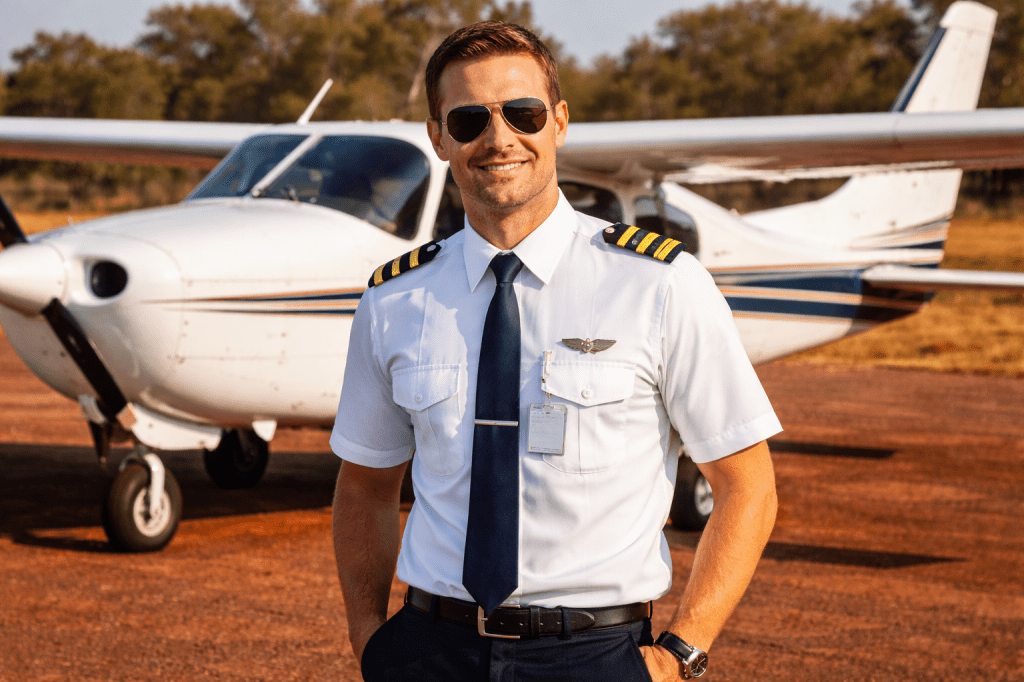
Most passengers have the same private question the moment the door closes, ‘Are we in good hands?’ It’s a fair instinct, because aviation is one of those domains where the machine is only half the story. The other half is human performance, what the pilot notices, how they think, and whether they do the right thing when things start to go wrong. The awkward part is that the very best pilots are hard to ‘spot’, because their work is designed to look uneventful. A great flight often feels like nothing happened at all.
So what does a good pilot look like, in a way that stands up to scrutiny rather than vibe? The most defensible answer is that ‘good’ is not a personality type, it’s a repeatable capability built from knowledge, skills, experience, and behaviour, especially under pressure. Safety research keeps circling these same themes, across both commercial and general aviation, because when accidents are analysed, the weak links are often found in decision errors, skill-based slips, and risk-taking, rather than a lack of horsepower or hardware. (ScienceDirect)
1) Knowledge, the part you never see, but you can sometimes hear
In practice, knowledge is a pilot’s ability to build an accurate mental model of what is happening, and what could happen next. It includes aircraft systems and limitations, weather, terrain, procedures, and the operator’s rules. That sounds academic, but it shows up in the real world as a pilot who is rarely surprised.
One of the strongest evidence-backed examples is weather. Weather decisions are not just about reading a forecast, they’re about recognising patterns, searching for the right information, and updating decisions as conditions evolve. Research into aeronautical weather decision making has found measurable differences between more and less experienced pilots in how they acquire information and how they process cues in weather scenarios, which is basically a scientific way of saying, good pilots don’t just ‘look’, they know what to look for, and they do it early. (ResearchGate)
From the cabin, you can’t test a pilot’s knowledge directly, but you can sometimes hear whether the operation is thinking clearly. When a pilot explains a delay in terms of specific constraints, wind, cloud base, visibility, crosswind, fuel requirements, alternates, that’s usually a sign of real situational understanding. This isn’t a guarantee, but vague confidence is often a warning sign.
2) Skills, what they can do, especially when the workload spikes
Skills are the applied side of knowledge, flying the aeroplane accurately, managing energy, running checklists, communicating, and keeping ahead of the aircraft rather than reacting behind it.
The skill that most often separates ‘fine’ from ‘excellent’ is not smoothness, it’s disciplined approach management. Aviation has a very plain concept called a ‘stabilised approach’. It means the aircraft is configured for landing, on the correct path, at the correct speed, by a defined gate, so the final segment is predictable rather than improvised. If those conditions are not met, the safe decision is usually a go-around, abandoning the landing, climbing away, and either trying again or diverting. A go-around is not a failure, it’s a normal safety tool.
Why does this matter? Because the approach and landing phase is where risk concentrates, and studies repeatedly link unstable approaches to poor landing outcomes, including runway excursions, when an aircraft departs the runway surface. (ScienceDirect)
From a passenger’s perspective, the trap is judging skill by the softness of the landing. A firm landing can be the correct landing on a wet runway or in gusty winds. A silky landing after an unstable approach can be luck. The higher-quality signal, though often invisible, is whether the pilot and the operator have the discipline to go around without drama.
3) Experience, not just hours, but relevance and recency
Experience is often misunderstood as a single number, ‘How many flight hours?’ Hours matter, but they’re a blunt instrument. What matters more is relevant experience and recency.
Recency is simple, how recently a pilot has practised the exact tasks they may need today. You can be highly experienced and still be ‘cold’ if you have not flown much recently, or if you have not flown that route type, that weather regime, that operating environment, in a while. This is one reason regulators and operators lean so heavily on recurrent checks and structured refreshers, because skill decay is real, even in professionals.
For passengers, this means the safest pilot is not always the one with the biggest lifetime number, it’s the one who is current and practised in the exact kind of flying you’re doing today. A pilot who flew thousands of hours years ago but has had long gaps, or hasn’t been operating recently in remote strips, challenging weather, or busy approaches, may be perfectly competent yet less sharp than a pilot with fewer total hours who flies that mission week in, week out and is regularly checked. The practical takeaway is to look for an operator that can clearly explain how they keep pilots ‘match-fit’, through recurrent training, line checks, and scenario practice that mirrors real conditions, rather than relying on experience alone.
4) Behaviour and attitude, the bit that decides whether the rest gets used well
This is where the conversation usually becomes uncomfortable, because ‘attitude’ sounds subjective. But safety research treats it as behavioural, measurable, and trainable. If knowledge is what a pilot understands, and skill is what they can execute, attitude is what they choose to do when the flight stops being neat.
A good pilot’s attitude starts with professional humility, the recognition that experience does not make you immune to error, and that the environment does not negotiate. This is why the best crews are comfortable saying ‘I don’t like this setup’, or ‘let’s reset’, without it feeling like a personal defeat. They don’t treat caution as weakness, they treat it as information.
Closely tied to that is discipline under friction. Aviation rarely fails in one dramatic moment. It frays. The call you didn’t quite hear, the descent you started a little late, the runway that looks a bit shorter than expected, the tailwind that’s crept up. Pilots with the right attitude have a low tolerance for ‘we’ll tidy it up later’. They stabilise early, they adhere to gates, they run checklists properly, and when the criteria are not met they go around decisively, not after negotiating with themselves.
Then there is risk awareness, which is not the same as risk aversion. Good pilots do not avoid complexity, they manage it. They recognise common human traps like plan continuation bias, the tendency to press on with the original plan because turning back feels costly, and they actively build decision points that make it easier to change course early. That might mean pre-briefing a diversion, agreeing on a hard ‘no later than’ time, or deciding in advance what weather or runway condition triggers a different plan.
A strong attitude also shows up as respect for the system. That includes respecting SOPs (standard operating procedures), not as bureaucracy but as a shared safety language, and respecting the roles of everyone involved, engineers, dispatch, other crew, even passengers. It is the willingness to listen, invite challenge, and take input seriously.
Finally, there is calm authority. Not performative confidence, but steady, predictable decision making that keeps stress from spreading. Passengers feel this, even if they cannot name it. The captain who communicates clearly, owns delays without defensiveness, and treats changes as normal operational decisions is often signalling a deeper truth, they are not flying to impress anyone, they are flying to arrive safely, every time.
So, can the average person spot a good pilot?
Not with certainty, and anyone who claims you can is selling something. You cannot see a pilot’s training record, recency, or decision quality from seat 3A. But you can sometimes spot the markers of a professional safety culture, and those markers correlate with the kind of pilots you want flying you.
Think of it as reading the operation, not judging the individual.
Green flags, what professionalism tends to look like
Calm, specific communication. Not over-sharing, not bravado, just clear reasons for decisions.
Normalising the ‘unsexy’ safety tools. Delays, diversions, and go-arounds are spoken about as routine options, not as embarrassment.
Standardisation. Checklists, briefings, and procedures feel consistent. That consistency is usually a symptom of disciplined training, not personality.
Boundaries are respected. If weight, weather, or timing constraints are mentioned, they’re treated as non-negotiable realities, not inconveniences.
Red flags, what should make you pause
Vagueness when you ask a reasonable question. ‘Don’t worry about it’ is not a safety philosophy.
Pressure language. ‘We have to get in’, ‘we’ll make it work’, particularly around weather.
A culture that treats conservative decisions as weakness. In aviation, conservatism is often competence with a longer time horizon.
Rushing. Shortcuts in briefing or process can be harmless, but they can also be the visible tip of a deeper pattern.
Passenger-friendly questions that actually map to pilot quality
If you want to ask something without sounding like you’re interrogating the crew, keep it operational and normal:
- ‘If the weather changes quickly, what’s the usual plan, hold, divert, or come back?’
- ‘Do you have stabilised approach criteria and a go-around policy you follow?’
- ‘How do pilots stay current on these routes, especially if flying is seasonal?’
You’re not looking for a long answer, you’re listening for tone. A professional operation answers plainly and respectfully, and doesn’t take offence at sensible curiosity.
The bottom line
A good pilot is not defined by charisma, confidence, or a buttery landing. They are defined by how reliably they apply knowledge, skills, experience, and disciplined behaviour when the flight stops being routine.
And for passengers, the best practical takeaway is this: you may not be able to ‘spot’ a great pilot, but you can learn to recognise a great safety culture, and that’s usually where great pilots are made, supported, and kept sharp.
 Jellywire Aviation
Leave a comment