
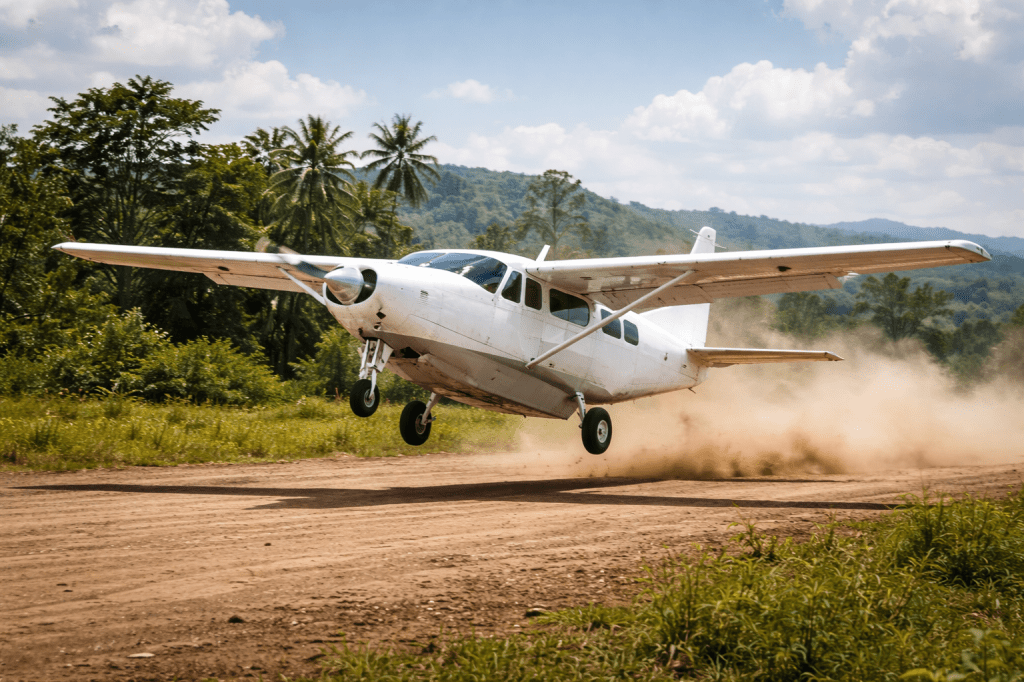
Humanitarian aviation is the organised use of aircraft, crews, maintenance, operational control, safety systems, and ground support to enable humanitarian and development outcomes where surface transport and normal commercial air links are unavailable, unsafe, or insufficient. In plain terms, it provides access, delivered through aviation, to places where isolation is not a story detail but the defining constraint.
You can see this idea across the way major humanitarian aviation organisations describe their work. The World Food Programme frames the United Nations Humanitarian Air Service (UNHAS) as reaching locations where there is ‘no safe or reliable’ air transport, which is often because commercial options do not exist or cannot operate safely, not simply because a disaster has just happened. (cdn.logcluster.org) Mission Aviation Fellowship (MAF) describes its purpose as overcoming ‘the barriers of isolation’ by using aviation to connect remote communities with vital services and goods, delivered through partnerships with hundreds of agencies. (MAF Australia) Aviation Sans Frontières (ASF) explicitly positions itself as a humanitarian air operator supporting humanitarian and development actors through passenger and freight transport and other aviation enabled missions. (ASF Belgium) Air Serv describes its role as providing air transportation to the global humanitarian community, a ‘bridge’ into hard places. (Air Serv International, Inc.)
What humanitarian aviation looks like in practice
It helps to think in three overlapping ‘modes’, which most providers move between as need shifts.
1) Sustained access in chronic isolation
This is the day to day work that rarely makes headlines, supporting health, education, community services, livelihoods, and governance in places where distance, terrain, wet seasons, lack of roads, or lack of safe commercial aviation create a permanent access gap. MAF is a clear example of this ‘system’ posture, it exists to overcome isolation and partners with large numbers of mission, humanitarian, and development organisations to reach people who would otherwise be cut off.
2) Common user services for multi agency operations
In many crises and protracted conflict settings, the operational challenge is not just ‘get in once’, it is ‘keep the response functioning’. UNHAS is built for this, providing a shared air service that allows humanitarian agencies to reach field locations where there is no safe or reliable alternative, reducing duplication and improving predictability across a response.
3) Surge response when the system shocks
After earthquakes, cyclones, floods, and sudden conflict escalation, aviation becomes the fastest way to move people, medical capability, and time critical supplies, and to restore a minimum level of connectivity for coordination and assessment. ICAO’s HADRA (Humanitarian and Disaster Response Initiative) work exists because aviation is so central in these moments, and because poor coordination, unclear procedures, and capacity constraints at airports can slow life saving activity.
Why humanitarian aviation is important
It turns ‘reach’ into a designable capability.
Humanitarian outcomes depend on being able to get the right people and the right items to the right place at the right time. In many environments, that is not a logistics footnote, it is the main constraint. Aviation turns access from an improvised workaround into something that can be planned, prioritised, and audited, with safety and duty of care at the centre. This governance theme is emphasised in UNHAS operational standards and the broader push for shared aviation safety and operating frameworks. (cdn.logcluster.org)
It protects people, including patients and staff.
Humanitarian aviation often includes medical evacuation and security evacuation, plus time critical transfer of clinicians and supplies. MAF highlights emergency medical help and rapid access when other transport is not possible, while common services like UNHAS are frequently relied upon for safe staff movement in insecure settings.
It can reduce waste in resource constrained responses, even though aircraft are expensive.
Aviation is costly per kilogram, but cost effectiveness is about total system cost, not a single line item. When access fails, programmes lose days, miss windows, duplicate movements, and burn scarce staff time. Shared services, disciplined flight placement, and common standards can reduce fragmentation, and help multiple organisations avoid each building its own bespoke solution. This is one reason specialist operators like Air Serv and MAF exist, to provide reliable air transport where other carriers cannot or will not.
It supports development outcomes, not only emergency relief.
ASF’s mission statement explicitly couples humanitarian and development actors, and MAF’s core narrative is long term service to isolated communities through partnerships, which reflects a reality many practitioners recognise, the same airstrip that receives disaster relief today is the airstrip that keeps routine health and education possible tomorrow.
The bottom line
Humanitarian aviation is best understood as enabling activity, delivered through aircraft, people, and systems, designed to make essential services possible where geography, infrastructure, and risk would otherwise block them. It matters because it converts isolation from an absolute barrier into a manageable operating problem, and in doing so it protects lives, improves reliability, and strengthens the entire humanitarian and development delivery chain.
 Jellywire Aviation
Leave a comment