
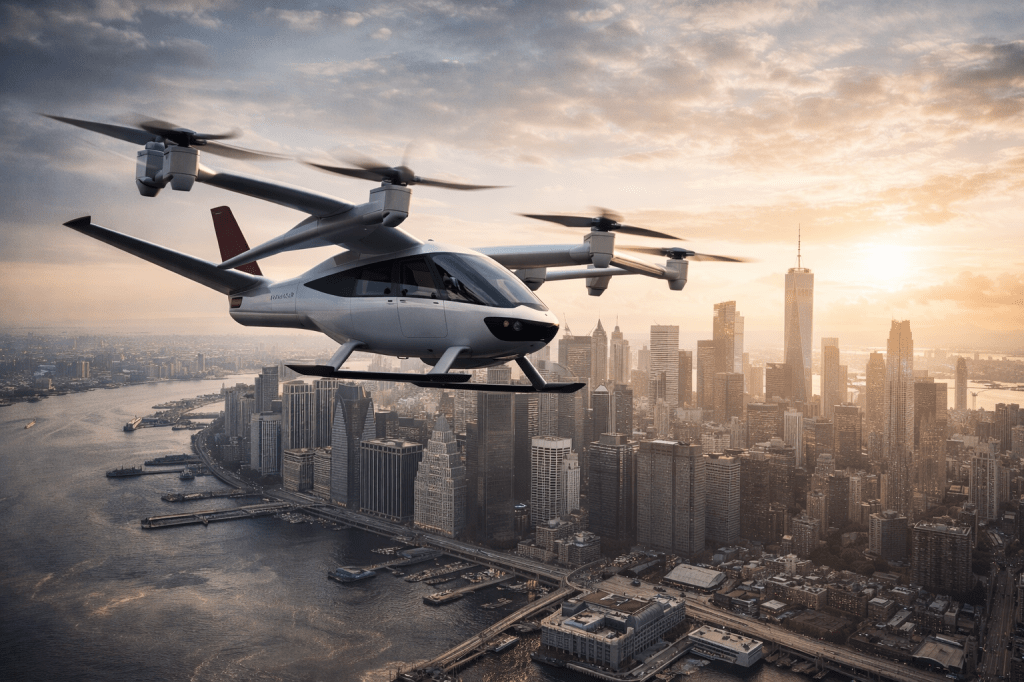
eVTOLs: Brilliant machines, brutal economics
I really want to be proved wrong on this, because I cannot think of many cooler things than electric air taxis. The idea is irresistible: quiet, clean aircraft lifting vertically from city rooftops, hopping over congestion, and turning a painful 90 minute commute into a 12 minute flight. It feels like the future as we were promised it.
And yet, for all the engineering brilliance and investor excitement surrounding eVTOLs (electronic vertical takeoff and landing)it is still remarkably difficult to see how many of these aircraft will support genuinely sustainable business models.
That is not because the technology is uninteresting. Quite the opposite. eVTOLs sit at the intersection of battery development, electric propulsion, advanced flight control systems, lightweight materials, autonomy, and a complete rethinking of urban transport. It is one of the most ambitious attempts in modern aerospace to create an entirely new category of aviation. The problem is that breakthrough technology does not automatically produce durable economics.
That is the central tension in the eVTOL story. The aircraft are exciting. The capital is real. The prototypes are flying. Certification pathways are becoming clearer. But once the novelty wears off, these companies will face the same unforgiving question that every aviation venture eventually faces: who pays, how much, and how often?
The first challenge is that eVTOL operators are not simply launching an aircraft, they are trying to launch an ecosystem. A conventional airline can buy aircraft, hire crews, and operate through an airport system that already exists. eVTOL companies must do far more. They need aircraft certification, pilot training systems, maintenance capability, charging infrastructure, vertiports, traffic management integration, public acceptance, and regulatory approval for operations in dense urban environments. Each one of these is difficult. Together, they represent an extraordinary burden of complexity and cost.
That matters because transport businesses rarely fail on concept alone, they fail on infrastructure friction. It is not enough for the aircraft to work. The entire chain around the aircraft has to work reliably, safely, and at a price customers will tolerate. In practice, that means the commercial success of eVTOLs depends as much on ground systems as airborne systems.
Then there is utilisation, the silent killer of many aviation business plans. Most investor presentations assume impressive daily aircraft use, fast turnarounds, predictable demand, and limited downtime. Real life is usually less kind. Aircraft require maintenance. Batteries degrade. Weather interrupts schedules. Noise constraints shape operating windows. Vertiport access creates bottlenecks. Passenger demand peaks at certain times and weakens at others. Every one of these factors chips away at utilisation, and in aviation poor utilisation can destroy economics very quickly.
This is especially important because eVTOLs are often pitched as premium urban mobility. That means the business case may depend on high yields from relatively affluent passengers. But premium transport markets can be surprisingly narrow. Plenty of people like the idea of flying over traffic. Far fewer will pay a substantial premium for it every day. The danger is that eVTOLs end up caught between two worlds: too expensive to become mass transit, but not valuable enough to sustain a large premium market.
That tension becomes sharper when compared with the transport alternatives already available. In many cities, helicopters already provide a version of this service, but remain niche because they are expensive, noisy, and operationally constrained. eVTOL advocates argue, rightly, that electric aircraft could reduce some of those disadvantages. But reducing them is not the same as eliminating them. If the outcome is still a premium service requiring specialised infrastructure, high regulatory oversight, and significant operating discipline, then the addressable market may still be much smaller than the rhetoric suggests.
There is also a deeper aviation truth here: lower direct operating cost does not always translate into a strong business. Even if an eVTOL is cheaper to run than a helicopter on an energy basis, the operator still has to absorb capital costs, support systems, infrastructure partnerships, staffing, insurance, compliance, and the commercial cost of building trust in a new mode of transport. Aviation history is full of aircraft that were technically capable but commercially weak because the total system cost remained too high.
Another challenge is that many eVTOL business models appear to rely on an unusually optimistic convergence of events. Battery technology must improve enough to deliver meaningful range, payload, and lifecycle economics. Certification must proceed without prolonged delay. Urban regulators must approve operations at scale. Communities must accept more aircraft overhead. Infrastructure must be built in the right places. Customers must be willing to pay. And competitors must not flood the market and drive margins down. Any one of those assumptions looks manageable in a slide deck. Taken together, they form a very fragile commercial proposition.
This does not mean eVTOLs are doomed. It means the most credible future for them may be narrower and more specialised than the original vision of airborne ride sharing for the masses. The strongest early use cases may not be urban commuters at all. They may be airport shuttles on defined routes, premium resort transfers, corporate transport, medical logistics, offshore support, regional links, or government backed mobility services where speed has a measurable economic or social value. In those environments, operators may be able to control infrastructure, operate predictable sectors, and charge prices that reflect genuine time savings or mission critical access.
That may sound less glamorous than the dream of thousands of air taxis criss-crossing city skylines, but it is probably more realistic. Aviation markets tend to mature from specific high value use cases outward, not from broad lifestyle branding inward. If eVTOL companies can prove reliability and economics in constrained, high value niches, they may earn the right to expand. If they try to leap straight to mass urban mobility, many may burn through capital long before demand truly materialises.
There is also a risk that the eVTOL sector has, in some cases, borrowed the language of software disruption for a business that will always remain heavily physical, regulated, and operationally unforgiving. Aircraft are not apps. You cannot scale them with code alone. You need hardware, maintenance, safety oversight, energy supply, trained people, and public confidence. In other words, you need to do aviation, and aviation has always been one of the hardest industries in which to make money consistently.
That is why scepticism is not cynicism. It is perfectly possible to admire the technology while doubting the economics. In fact, that may be the most serious way to view the sector. eVTOLs deserve rigorous scrutiny precisely because they are such a compelling idea. If they work, they could reshape parts of mobility, reduce emissions in certain segments, and open up transport options that do not exist today. But if their economics remain weak, then they may join the long list of elegant aerospace concepts that inspired headlines without ever producing enduring returns.
The future of eVTOLs may therefore depend less on whether they can fly, and more on whether they can earn. That is a much less romantic question, but it is the one that matters. And until the industry can show repeatable answers on utilisation, infrastructure, pricing, maintenance, certification, and demand, the scepticism will remain justified.
Perhaps that will change. Perhaps battery performance will improve faster than expected. Perhaps urban authorities will embrace vertiports. Perhaps a handful of operators will identify disciplined, profitable niches and build from there. I genuinely hope so. Electric air taxis are one of those ideas that make the future feel exciting again.
But aerospace history suggests a hard rule: cool does not pay the bills. Sustainable business models do. And that is the test eVTOLs still have to pass.
 Jellywire Aviation
Leave a comment