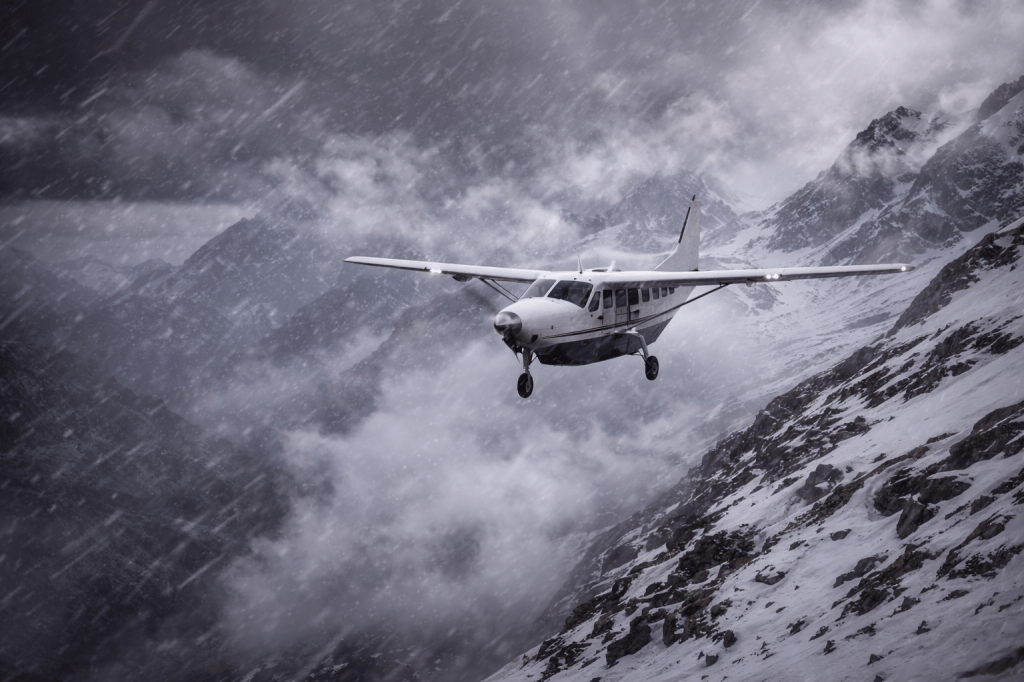
Weather and terrain are always part of flying, but in remote, high-risk charter operations they matter more because you’ve got fewer back-up options. Fewer diversion airports, more unsealed or short runways, more ‘one road in, one way out’ geography, and often more pressure to ‘get the job done’. That mix is exactly why good remote operators are obsessive about planning, and why delays and cancellations are often a sign the system is working.
Here’s the Jellywire Aviation Essentials guide to how terrain and weather create risk in remote charter flying, what you’ll notice as a passenger, and how you can reduce your personal risk.
The remote charter reality, options are everything
When flying between big cities, if the destination goes bad you often have multiple alternates nearby, with long sealed runways, fuel, lighting, instrument approaches, and ground support.
In remote charter flying, you might have:
- One usable runway, sometimes short, sometimes unsealed
- No instrument approach, or only basic guidance
- Limited fuel availability, sometimes none at destination
- Few alternates within practical range
- Weather that changes fast, especially in wet seasons, tropical build-ups, or mountainous areas
- Terrain that forces routes, river valleys, ridgelines, coastlines, ‘threading the needle’ between weather and hills
So the biggest risk isn’t usually one dramatic thing, it’s the gradual loss of options. Remote aviation safety is basically the art of never letting yourself get boxed in.
Terrain risk in remote ops, the land shapes the air
1) Terrain makes wind messy and unpredictable
Wind over flat land can be fairly consistent. Wind over terrain gets twisted. Three effects matter most:
Rotor turbulence (downwind of ridges)
Imagine water flowing over a rock, then churning behind it. Air does the same behind hills and ridgelines. If you’re flying downwind of a ridge, the air can be rough, even on a clear day.
Mountain wave
Air can oscillate up and down for long distances after crossing terrain. It can create smooth ‘rollercoaster’ vertical motion or severe turbulence, depending on strength.
Venturi effect (wind accelerates through gaps)
If the route follows a valley or a pass, wind can funnel and speed up. That can increase crosswinds at a strip and increase turbulence along the approach.
Passenger clue: turbulence that’s strongest near terrain or on approach is often terrain-wind interaction, not ‘bad flying’.
2) Terrain reduces escape routes
In remote settings, a strip might sit in a valley or near rising ground. If cloud lowers or rain moves in, you can’t just descend anywhere and ‘have a look’. Terrain means:
- Turning around may require space you don’t have
- Descending may put you too close to obstacles
- Climbing may not be possible quickly if the aircraft is heavy, it’s hot, or you’re in downdrafts
This is why remote pilots often make earlier decisions, if the weather looks like it’s trending the wrong way, they’ll turn back sooner than you’d expect.
3) Terrain creates visual traps
Even when the weather is ‘OK’, terrain can mess with perception:
- Runway slope illusion: an upslope runway can look closer, a downslope runway can look farther away
- Narrow runway illusion: narrow strips can look longer and farther away, tempting a steep approach
- Haze and glare: low sun over ridgelines or dust haze can flatten the scene and hide rising ground
- Featureless terrain: over water, sand, or uniform scrub, your eyes lose depth cues
Passenger clue: if you see the pilot take extra time briefing the approach or you hear lots of altitude and position callouts, that’s them actively managing visual illusions.
Weather risk in remote ops, the invisible squeeze
1) Wind and runway limits
Remote strips often have stricter practical limits than a big airport because they are:
- shorter
- narrower
- unsealed
- sometimes crowned, undulating, or soft after rain
- surrounded by obstacles (trees, terrain, structures)
Wind matters in three ways:
Tailwind increases landing and take-off distance
A small tailwind can significantly increase runway needed. On a remote strip that can be the difference between ‘comfortable margin’ and ‘no margin’.
Crosswind can exceed the strip’s real usability
Even if the aircraft can handle a given crosswind on a sealed runway, an unsealed strip with limited braking and directional control may effectively reduce what’s safe.
Gusts can cause sudden loss of performance near the ground
Gusts change airspeed quickly. Near the ground there’s less time to correct.
Passenger clue: if the aircraft lines up and then taxis back, or does a low approach and goes around, that can be wind and runway limits, not indecision.
2) Visibility and cloud
Remote charter flights are often visual operations, meaning the pilot relies on outside references. Even if the aircraft and pilot can fly on instruments, the destination might not support a safe instrument arrival.
Key problems:
- Low cloud over the strip means you might not be able to descend safely
- Rain shafts can reduce visibility quickly, especially in the tropics
- Smoke, dust, haze can make the horizon disappear, which increases disorientation risk
- Scud running temptation, staying low under cloud, is dangerous because terrain and obstacles get close fast
Passenger clue: when cloud is low and broken, remote pilots can be very conservative because a ‘gap’ can close unexpectedly.
3) Thunderstorms
In remote areas, storms can be more isolated and fast-forming, especially in wet seasons. Thunderstorms can contain:
- severe turbulence
- strong updrafts and downdrafts
- lightning
- hail
- microbursts, powerful downward blasts near the ground
Microbursts are particularly nasty on approach or take-off because they can suddenly remove headwind and replace it with tailwind, reducing lift when you’re low.
Passenger clue: if you can see towering vertical cloud with sharp edges, dark bases, anvil tops, or lightning, expect delays or diversions. That’s a safety win.
4) Rain
Rain changes airstrip performance in remote ops far more than most passengers realise.
- Sealed runway: wet increases stopping distance
- Unsealed runway: wet can mean soft patches, puddles hiding ruts, reduced directional control, and sometimes bog risk
- Grass strips: can become slippery, affecting braking and steering
Passenger clue: if it’s been raining hard and you’re going to a dirt strip, a delay or cancellation is often about runway condition, not airworthiness.
5) Heat and ‘thin air’
Remote operations often happen in hot climates. Hot air is less dense, and less dense air means:
- wings generate less lift at the same speed
- engines produce less power
- propellers are less efficient
- take-off roll increases
- climb rate decreases
This is called density altitude. It’s the single most important ‘quiet risk’ in hot remote ops, especially with heavy loads and short strips.
What it looks like in practice:
- weight limits become tighter
- flights may depart earlier or later to use cooler air
- the operator might split loads into multiple flights
- the pilot may use longer take-off techniques or reject the take-off sooner if acceleration isn’t right
Passenger clue: if you’re asked to reduce baggage, move seats, or leave freight behind on a hot day, it’s usually performance maths, not inconvenience theatre.
6) Icing
In colder regions or at altitude, ice can form in cloud. Small and medium charter aircraft may have limited ice protection compared to big airliners.
Ice reduces lift and increases drag, which is a double hit. It can also affect propellers and sensors.
Passenger clue: route changes to avoid cloud layers in cold conditions are normal and sensible.
The highest-risk pattern in remote charter flying: stacked factors
Remote accidents and serious incidents often trace back to factors stacking up:
- marginal visibility + rising terrain
- gusty crosswind + short or soft strip
- hot day + heavy load + obstacle-limited climb
- storms nearby + pressure to arrive before closure
- limited alternates + low fuel flexibility
Notice the theme: risk climbs fastest when options shrink. Professional operators protect options.
What you can do as a passenger, practical risk mitigation
You can’t fly the aircraft, and you shouldn’t try. But you can lower risk by reducing pressure, increasing your own preparedness, and choosing safer operators.
1) Choose an operator that treats delays as normal
Green flags in remote charter:
- They brief you clearly, without rushing
- They mention weather and runway condition unprompted
- They are happy to delay, re-route, or split loads
- They enforce baggage limits and seatbelts
- They don’t overpromise arrival times
- Their staff use checklists, and you can see a calm, procedural vibe
Red flags:
- ‘We always get in’ talk
- Annoyance at weather-related delays
- Joking about limits
- Rushing turnarounds, minimal briefing
- Pressure language like ‘we’ll just have a quick look’
2) Ask two smart, non-confrontational questions
These are passenger-appropriate and tell you a lot about the safety culture:
- ‘What’s the plan if the destination weather drops in while we’re en route, return, divert, or hold?’
A good operator will answer calmly, and the answer will include alternates and decision points. - ‘Are there any expected bumps on the way, should we stay belted?’
Good operators will encourage seatbelts, especially in remote turbulence-prone regions.
If the response is defensive or vague, that’s information.
3) Keep your seatbelt snug whenever seated
In remote flying, turbulence can be more abrupt near terrain and storm build-ups. The easiest personal risk reduction is simply staying belted. Most turbulence injuries are avoidable.
4) Don’t be the person who adds last-minute weight
Weight is performance. In remote ops, performance is safety margin.
- Follow baggage limits
- Keep heavy items low and secured
- Declare batteries and dangerous goods properly
- Don’t sneak extra gear onboard
If you’ve got mission-critical freight, accept that it may need a dedicated flight.
5) Pack like delays are normal
This reduces pressure on you and on the operation.
Carry on:
- Essential medication
- Water and snacks
- A light layer, even in warm climates
- Head torch if travelling into remote areas
- Phone fully charged
Pressure makes people push. Comfort and preparedness make it easier to wait.
6) Know what a good briefing sounds like
A remote charter briefing should cover:
- Seatbelts, doors, emergency exits
- How to use headsets if provided
- No-go zones around propellers or rotors
- What to do if you feel unwell
- Securing baggage
- A clear instruction to stay belted when told
If none of that happens, that’s a culture signal.
7) If you feel uneasy, say it early and simply
You can remove social pressure with one sentence:
- ‘I’m happy to wait if conditions aren’t right.’
That tells the crew you’re not going to be the passenger who complains them into risk.
How to interpret common remote charter ‘events’ without panic
A go-around (approach then climb away)
Often a wind change, turbulence, or an unstable approach. A go-around is a positive safety action.
Turning back
Often because the destination is trending worse or alternates are limited. In remote ops, turning back early protects options.
Offloading baggage or freight
Almost always weight and performance, especially hot days or short strips.
Longer route than expected
Could be weather avoidance, terrain clearance, or airspace constraints. Detours are normal.
Delays that feel ‘overcautious’
Remote aviation doesn’t have the same safety net as major airports. Conservative decisions are the safety net.
 Jellywire Aviation